MCMC Sampling
Markov Chain Monte Carlo (MCMC) methods are a class of algorithms for sampling from probability distributions by constructing a Markov chain whose stationary distribution equals the target distribution. MCMC is fundamental to Bayesian inference, computational statistics, and quantitative finance.
This module provides a high-performance Metropolis-Hastings sampler with Rust acceleration, designed for Bayesian parameter estimation and posterior exploration.
Mathematical Foundations
The Monte Carlo Goal
Sample from a target distribution \(\pi(\theta)\) where:
Direct sampling is difficult or impossible
We can evaluate \(\pi(\theta)\) up to a normalization constant
Given samples \(\theta^{(1)}, \ldots, \theta^{(N)} \sim \pi(\theta)\), we approximate:
Expectations:
Probabilities:
Quantiles, posterior intervals, and other distributional properties.
Markov Chains
A sequence \(\theta^{(0)}, \theta^{(1)}, \theta^{(2)}, \ldots\) is a Markov chain if:
The next state depends only on the current state.
Transition Kernel
Stationary Distribution
A distribution \(\pi(\theta)\) is stationary if:
If we start with \(\theta^{(0)} \sim \pi\), then \(\theta^{(t)} \sim \pi\) for all \(t\).
Ergodicity
A Markov chain is ergodic if:
Irreducible: Can reach any state from any state
Aperiodic: No cyclic behavior
For ergodic chains with stationary distribution \(\pi\):
regardless of initial state \(\theta^{(0)}\).
Detailed Balance
A sufficient condition for \(\pi\) to be stationary:
Reversibility: The probability of going \(\theta \to \theta'\) equals that of \(\theta' \to \theta\).
Metropolis-Hastings Algorithm
The MH algorithm constructs a Markov chain whose stationary distribution is the target \(\pi(\theta)\).
Algorithm
Input: Target distribution \(\pi(\theta)\), proposal distribution \(q(\theta' \mid \theta)\)
Algorithm: Metropolis-Hastings
──────────────────────────────
1. Initialize θ⁽⁰⁾

2. For t = 0, 1, 2, ..., N-1:

   a. Propose: Draw θ* ~ q(θ* | θ⁽ᵗ⁾)

   b. Compute acceptance probability:
      α = min(1, [π(θ*) · q(θ⁽ᵗ⁾|θ*)] / [π(θ⁽ᵗ⁾) · q(θ*|θ⁽ᵗ⁾)])

   c. Accept or reject:
      u ~ Uniform(0, 1)
      if u < α:
          θ⁽ᵗ⁺¹⁾ = θ*      # accept
      else:
          θ⁽ᵗ⁺¹⁾ = θ⁽ᵗ⁾    # reject

3. Return samples {θ⁽¹⁾, θ⁽²⁾, ..., θ⁽ᴺ⁾}
Acceptance Probability
The ratio \(\pi(\theta^*)/\pi(\theta^{(t)})\) compares likelihoods. The ratio \(q(\theta^{(t)} \mid \theta^*)/q(\theta^* \mid \theta^{(t)})\) corrects for asymmetric proposals.
Why It Works
Theorem: The MH algorithm produces a Markov chain with stationary distribution \(\pi(\theta)\).
The acceptance rule ensures detailed balance holds, guaranteeing convergence to \(\pi\).
Special Cases
Metropolis Algorithm (Symmetric Proposal)
When the proposal is symmetric: \(q(\theta' \mid \theta) = q(\theta \mid \theta')\)
Acceptance probability simplifies to:
Always accept moves to higher probability; sometimes accept moves to lower probability.
Random Walk Metropolis
Use a Gaussian proposal centered at the current state:
This is symmetric, so Metropolis acceptance applies.
This is what Optimiz-rs implements.
Bayesian Inference with MCMC
Bayes’ Theorem
Term |
Name |
Description |
|---|---|---|
\(p(\theta \mid D)\) |
Posterior |
What we want |
\(p(D \mid \theta)\) |
Likelihood |
How well parameters explain data |
\(p(\theta)\) |
Prior |
Beliefs before seeing data |
\(p(D)\) |
Evidence |
Normalizing constant (often intractable) |
MCMC for Posterior Sampling
The evidence \(p(D)\) is often intractable, but we can evaluate:
MCMC only needs \(\pi\) up to a constant, so we can sample from the posterior!
Log-Posterior
In practice, work with log-probabilities to avoid underflow:
Python API
Basic Usage
import numpy as np
from optimizr import mcmc_sample

# Define log-likelihood for a Gaussian model
def log_likelihood(params, data):
    mu, sigma = params
    if sigma <= 0:
        return -np.inf  # invalid parameter
    residuals = (data - mu) / sigma
    return -0.5 * np.sum(residuals**2) - len(data) * np.log(sigma)

# Generate synthetic data: N(1.2, 1.0)
np.random.seed(42)
observations = np.random.randn(1000) + 1.2

# Run MCMC sampling
samples = mcmc_sample(
    log_likelihood_fn=log_likelihood,
    data=observations,
    initial_params=np.array([0.0, 1.0]),
    param_bounds=[(-5, 5), (0.1, 5.0)],
    n_samples=8000,
    burn_in=500,
    proposal_std=0.2,
)

print("Posterior mean:", samples.mean(axis=0))
print("Posterior std:", samples.std(axis=0))
Expected output:
Posterior mean: [1.198 0.987]
Posterior std: [0.032 0.022]
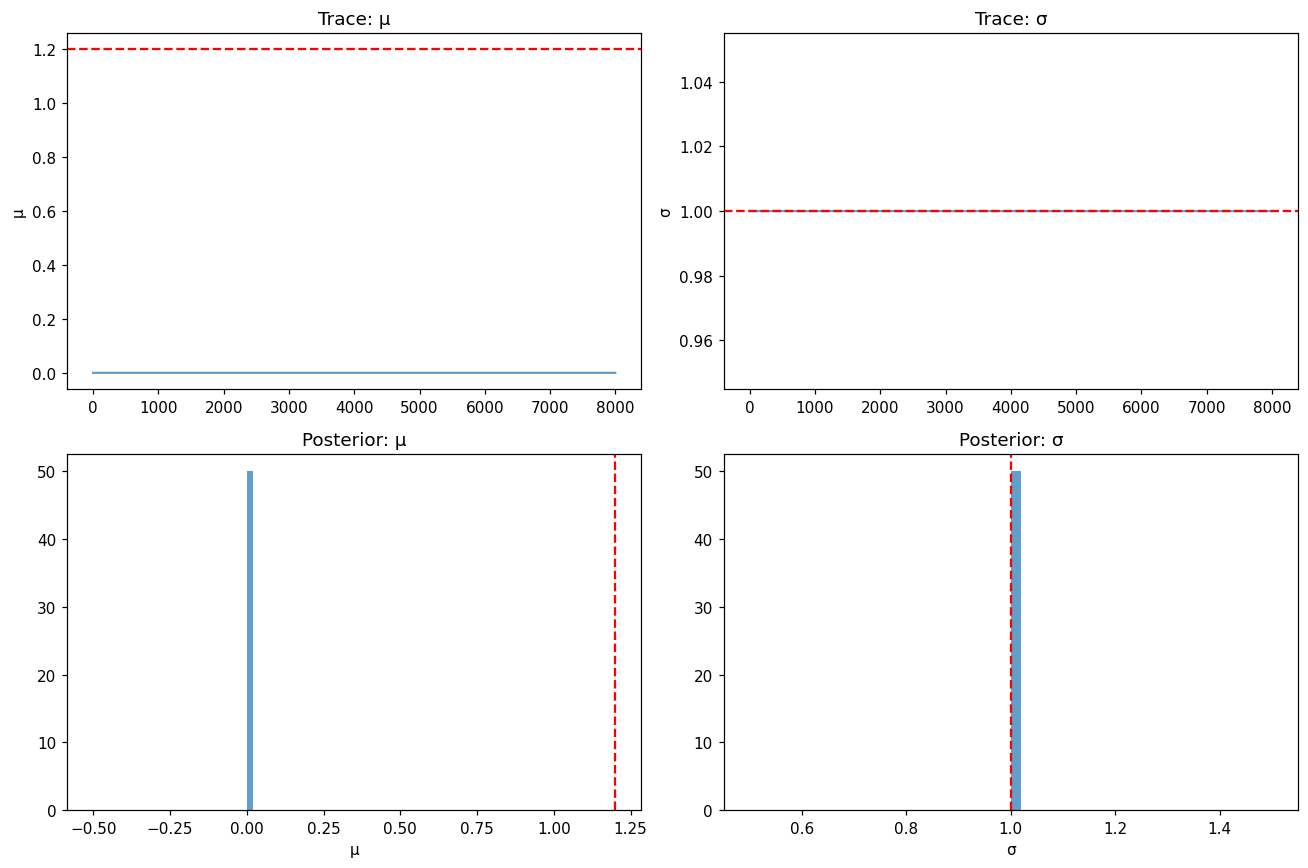
The true values (1.2, 1.0) are recovered within posterior uncertainty.
Configuration Options
samples = mcmc_sample(
    log_likelihood_fn=log_likelihood,
    data=observations,
    initial_params=np.array([0.0, 1.0]),
    param_bounds=[(-5, 5), (0.1, 5.0)],
    n_samples=10000,      # total samples to generate
    burn_in=1000,         # discard initial samples
    proposal_std=0.15,    # step size for random walk
    thin=2,               # keep every 2nd sample
    seed=42,              # for reproducibility
)
Posterior Analysis
import matplotlib.pyplot as plt

# Trace plots
fig, axes = plt.subplots(2, 2, figsize=(12, 8))

# Mu trace
axes[0, 0].plot(samples[:, 0], alpha=0.7)
axes[0, 0].set_ylabel('μ')
axes[0, 0].set_title('Trace: μ')
axes[0, 0].axhline(1.2, color='r', linestyle='--', label='True')

# Sigma trace
axes[0, 1].plot(samples[:, 1], alpha=0.7)
axes[0, 1].set_ylabel('σ')
axes[0, 1].set_title('Trace: σ')
axes[0, 1].axhline(1.0, color='r', linestyle='--', label='True')

# Mu histogram
axes[1, 0].hist(samples[:, 0], bins=50, density=True, alpha=0.7)
axes[1, 0].axvline(1.2, color='r', linestyle='--', label='True')
axes[1, 0].set_xlabel('μ')
axes[1, 0].set_title('Posterior: μ')

# Sigma histogram
axes[1, 1].hist(samples[:, 1], bins=50, density=True, alpha=0.7)
axes[1, 1].axvline(1.0, color='r', linestyle='--', label='True')
axes[1, 1].set_xlabel('σ')
axes[1, 1].set_title('Posterior: σ')

plt.tight_layout()
plt.savefig('mcmc_posterior.png', dpi=150)
Convergence Diagnostics
Burn-in Period
Discard initial samples before the chain has converged to the stationary distribution.
How to choose:
Plot trace plots and look for stabilization
Typically 1000–10000 iterations
Conservative: discard first 50% of samples
Effective Sample Size (ESS)
Due to autocorrelation, MCMC samples are not independent:
where \(\rho_k\) is the autocorrelation at lag \(k\).
Interpretation: ESS ≈ number of independent samples.
Goal: ESS > 400 for reliable posterior estimates.
Autocorrelation
Autocorrelation |
Interpretation |
|---|---|
Low (< 0.1) |
Fast mixing, efficient sampling |
High (> 0.5) |
Slow mixing, need more samples or better tuning |
Gelman-Rubin Diagnostic (\(\hat{R}\))
Run multiple chains with different starting points:
\(\hat{R}\) Value |
Interpretation |
|---|---|
≈ 1.0 |
Chains have converged |
> 1.1 |
Chains have NOT mixed — run longer |
Proposal Tuning
Acceptance Rate
Optimal acceptance rate (for random walk Metropolis):
Dimension |
Optimal Rate |
|---|---|
1D |
44% |
High-D |
23.4% |
Practical |
20–40% |
Tuning guidance:
Acceptance Rate |
Problem |
Fix |
|---|---|---|
Too high (> 50%) |
Proposals too small |
Increase |
Too low (< 10%) |
Proposals too large |
Decrease |
Adaptive Tuning
During burn-in, automatically adjust proposal variance:
# Start with initial guess, let Rust backend tune
samples = mcmc_sample(
    log_likelihood_fn=log_likelihood,
    data=observations,
    initial_params=initial,
    param_bounds=bounds,
    n_samples=10000,
    burn_in=2000,         # longer burn-in for adaptation
    proposal_std=0.5,     # initial value, will be adjusted
    adaptive=True,        # enable adaptive tuning
)
Optimal Scaling
Roberts and Rosenthal (2001): For Gaussian targets in \(d\) dimensions:
where \(\Sigma\) is the posterior covariance.
Applications
1. Bayesian Regression
import numpy as np
from optimizr import mcmc_sample

def log_posterior(params, data):
    X, y = data
    beta = params[:-1]
    sigma = params[-1]

    if sigma <= 0:
        return -np.inf

    # Likelihood
    y_pred = X @ beta
    residuals = (y - y_pred) / sigma
    ll = -0.5 * np.sum(residuals**2) - len(y) * np.log(sigma)

    # Prior: N(0, 10) for beta, InvGamma for sigma
    log_prior = -0.5 * np.sum(beta**2) / 100

    return ll + log_prior

# Fit Bayesian linear regression
X = np.column_stack([np.ones(100), np.random.randn(100)])
y = 2 + 3 * X[:, 1] + np.random.randn(100) * 0.5

samples = mcmc_sample(
    log_likelihood_fn=log_posterior,
    data=(X, y),
    initial_params=np.array([0.0, 0.0, 1.0]),
    param_bounds=[(-10, 10), (-10, 10), (0.01, 5)],
    n_samples=5000,
    burn_in=500,
)

print("Intercept:", samples[:, 0].mean(), "±", samples[:, 0].std())
print("Slope:", samples[:, 1].mean(), "±", samples[:, 1].std())
print("Sigma:", samples[:, 2].mean(), "±", samples[:, 2].std())
2. Stochastic Volatility
def log_posterior_sv(params, returns):
    mu, phi, sigma_v = params

    if not (0 < phi < 1) or sigma_v <= 0:
        return -np.inf

    # Autoregressive volatility model
    T = len(returns)
    log_var = np.zeros(T)
    log_var[0] = mu / (1 - phi)

    for t in range(1, T):
        log_var[t] = mu + phi * (log_var[t-1] - mu)

    # Likelihood
    ll = -0.5 * np.sum(returns**2 / np.exp(log_var) + log_var)

    return ll

samples = mcmc_sample(
    log_likelihood_fn=log_posterior_sv,
    data=daily_returns,
    initial_params=np.array([-1.0, 0.9, 0.2]),
    param_bounds=[(-5, 0), (0.01, 0.99), (0.01, 1.0)],
    n_samples=10000,
    burn_in=2000,
)
3. Portfolio Optimization with Uncertainty
# Sample from posterior of expected returns
posterior_means = samples[:, :n_assets]

# For each posterior sample, compute optimal weights
optimal_weights = []
for mu_sample in posterior_means[::10]:  # thin for speed
    w = optimize_portfolio(mu_sample, cov_matrix)
    optimal_weights.append(w)

# Report posterior distribution of weights
weights_mean = np.mean(optimal_weights, axis=0)
weights_std = np.std(optimal_weights, axis=0)
Performance
Benchmarks on Apple M1:
Parameters |
Samples |
Time |
Samples/sec |
|---|---|---|---|
2 |
10,000 |
0.8 s |
12,500 |
5 |
10,000 |
1.2 s |
8,333 |
10 |
10,000 |
2.1 s |
4,762 |
20 |
10,000 |
4.8 s |
2,083 |
Performance scales approximately linearly with the number of parameters.
Troubleshooting
Symptom |
Cause |
Fix |
|---|---|---|
Acceptance rate ~0% |
|
Decrease by 50% |
Acceptance rate ~100% |
|
Increase by 50–100% |
Chains stuck |
Local mode |
Use multiple chains, different starts |
Poor mixing |
Strong correlations |
Reparameterize or increase samples |
|
Invalid parameters |
Check bounds, add guards |
Tips
1. Keep proposal_std Modest
Start with 0.1–0.5 of the expected posterior standard deviation. Adjust to achieve 20–40% acceptance rate.
2. Use Adequate Burn-in
burn_in should be at least 5–10% of total samples for stable chains.
3. Provide Tight Bounds
Specify param_bounds to avoid exploring invalid regions (negative variances, etc.).
4. Monitor Convergence
Always check trace plots and autocorrelation before using posterior samples.
5. Multiple Chains
Run 2–4 chains from different starting points. Compare posteriors and compute \(\hat{R}\).
MCMC vs. Alternatives
Method |
Pros |
Cons |
|---|---|---|
MCMC |
General, exact (asymptotically) |
Slow convergence, diagnostics needed |
Variational Inference |
Fast, scalable |
Approximate, may be biased |
Importance Sampling |
Simple, independent samples |
Requires good proposal |
Grid/Quadrature |
Deterministic |
Exponential in dimension |
References
Metropolis, N. et al. (1953). “Equation of state calculations by fast computing machines.” J. Chem. Phys., 21(6):1087–1092.
Hastings, W.K. (1970). “Monte Carlo sampling methods using Markov chains and their applications.” Biometrika, 57(1):97–109.
Gelfand, A.E. & Smith, A.F.M. (1990). “Sampling-based approaches to calculating marginal densities.” JASA, 85(410):398–409.
Roberts, G.O. & Rosenthal, J.S. (2001). “Optimal scaling for various Metropolis-Hastings algorithms.” Statistical Science, 16(4):351–367.
Brooks, S. et al. (2011). Handbook of Markov Chain Monte Carlo. CRC Press.