Mathematical Foundations¶
This page develops the core mathematics underlying Optimiz-rs’s Rust kernels — from first
principles through advanced theory. Each section opens with a definition block, builds
intuition through examples and diagrams, and closes with a notebook micro-check.
For complete walkthroughs see examples/notebooks/.
1 · Differential Evolution (DE)¶
Background¶
DE is a gradient-free population-based optimizer for \(f: \mathbb{R}^d \to \mathbb{R}\), not required to be smooth or convex. At generation \(g\) we maintain \(N\) candidate solutions \(\{\mathbf{x}_{i,g}\} \subset \mathbb{R}^d\).
Key insight: The difference vector \(\mathbf{x}_{r_2}-\mathbf{x}_{r_3}\) is an unbiased directional finite-difference of \(f\), so DE implicitly estimates curvature without Jacobians.
1.1 Geometric Intuition — Mutation in \(\mathbb{R}^2\)¶
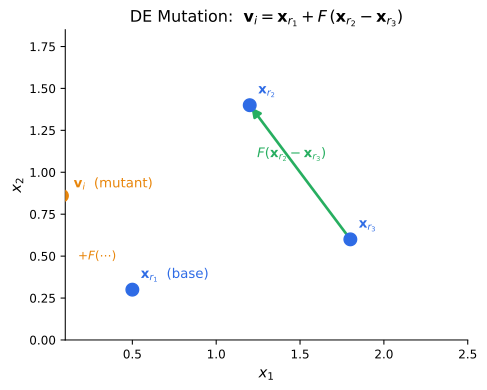
\(\mathbf{r}_1, \mathbf{r}_2, \mathbf{r}_3\) are three distinct randomly selected parents.
The mutant \(\mathbf{v}_i\) lands on the other side relative to \(\mathbf{x}_{r_1}\).
Crossover then mixes \(\mathbf{v}_i\) and \(\mathbf{x}_i\) dimension-by-dimension with probability \(CR\), producing trial vector \(\mathbf{u}_i\).
Selection keeps \(\mathbf{u}_i\) only if it improves over \(\mathbf{x}_i\) — pure greedy.
1.2 Operators¶
Step |
Formula |
Role |
|---|---|---|
Mutation (rand/1) |
\(\mathbf{v}_{i,g} = \mathbf{x}_{r_1} + F(\mathbf{x}_{r_2}-\mathbf{x}_{r_3})\) |
explore |
Binomial crossover |
\(u_{i,j} = v_{i,j}\) if \(U(0,1)<CR\) or \(j=j_\text{rand}\) |
mix dimensions |
Greedy selection |
\(\mathbf{x}_{i,g+1} = \mathbf{u}_{i,g}\) iff \(f(\mathbf{u})\le f(\mathbf{x})\) |
exploit |
Convergence (informal): Under bounded population diversity and Lipschitz \(f\), the best-so-far value converges a.s. to a stationary point as \(N,g\to\infty\) (Price et al. 2005).
1.3 Self-Adaptive jDE (Optimiz-rs default)¶
Parameters \(F,CR\) are per-individual and reset stochastically each generation:
\(\tau_1=\tau_2=0.1\) by default. On rugged landscapes this produces bimodal \(F\) histograms concentrated near 0.8 — a sign the landscape is highly multimodal.
1.4 Example — Minimising the Rastrigin Function¶
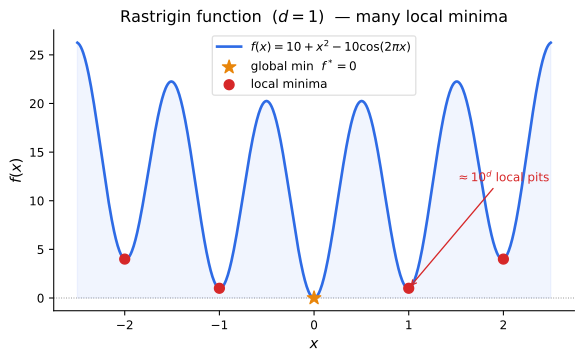
The Rastrigin function \(f(\mathbf{x}) = 10d + \sum_i[x_i^2 - 10\cos(2\pi x_i)]\) has \(\approx 10^d\) local minima (global minimum \(f^*=0\) at \(\mathbf{x}^*=\mathbf{0}\)).
Why gradient methods fail: The gradient \(\partial_{x_i}f = 2x_i + 20\pi\sin(2\pi x_i)\) oscillates rapidly — any gradient step hops between basins.
Why DE succeeds: The difference vector \(F(\mathbf{x}_{r_2}-\mathbf{x}_{r_3})\) spans the characteristic basin width (~1.0), enabling inter-basin jumps.
Typical jDE convergence (\(d=10\), \(N=100\), \(\tau_1=\tau_2=0.1\)):
Gen    Best f    Mean F    Mean CR
----   -------   -------   -------
  1     48.3      0.50      0.50
 50     12.1      0.78      0.31
200      3.4      0.82      0.24   <- F clusters near 0.8 (bimodal)
500      0.0      0.83      0.22   <- converged
Tip — Diagnosing Stagnation
If best-\(f\) does not decrease for 100+ generations:
Check \(F\) histogram. Bimodal near 0.8 -> landscape is multimodal (increase \(N\)). Collapsed near 0 -> diversity loss; restart with random perturbation.
Check \(CR\) distribution. Uniform -> dimensions not interacting. Collapsed near 0 -> DE treating dimensions independently (separable function).
Increase \(N\) to \(\approx 10d\) for \(d > 20\).
Notebook check (05_performance_benchmarks.ipynb): Plot \(F_i, CR_i\) histograms
every 50 generations; expect values clustering in \([0.5,0.9]\) on hard problems.
2 · Stochastic Processes¶
These form the probabilistic backbone of all continuous-time models in Optimiz-rs. We build the theory from scratch: random walk → Brownian motion → Itō calculus → SDEs → jump-diffusions.
2.1 Brownian Motion¶
2.1.0 Intuitive Construction — From Random Walk to BM¶
Step 1 — Discrete random walk. Flip a fair coin \(n\) times per unit time. Define \(\xi_k = +1\) (heads) or \(-1\) (tails) i.i.d. After \(n\) steps of size \(1/\sqrt{n}\):
By the Central Limit Theorem, as \(n\to\infty\): \(S^{(n)}_t \xrightarrow{d} W_t \sim \mathcal{N}(0,t)\).
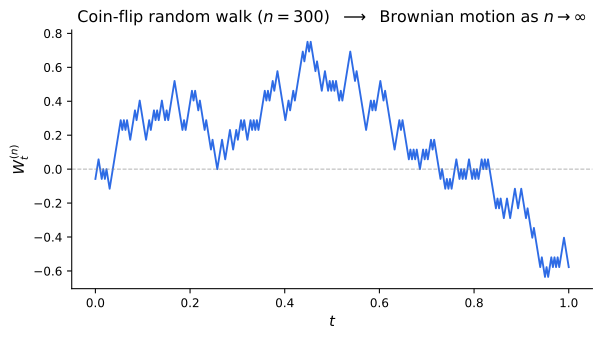
Step 2 — Scaling limit. The normalization \(1/\sqrt{n}\) is crucial:
Without it, variance grows as \(n\) (diverges).
With \(n^{-1/2}\): variance = \(n \cdot (1/\sqrt{n})^2 \cdot t = t\) — exactly right.
This is why \(W_t \sim \mathcal{N}(0,t)\): variance accumulates linearly in time.
Definition — Wiener Process
A stochastic process \(W = (W_t)_{t\ge 0}\) on \((\Omega,\mathcal{F},\mathbb{P})\) is a standard Brownian motion if:
\(W_0 = 0\) a.s.
Increments are independent: \(W_t - W_s \perp \mathcal{F}_s\) for \(t>s\).
\(W_t - W_s \sim \mathcal{N}(0, t-s)\) for all \(0\le s<t\).
Paths \(t\mapsto W_t(\omega)\) are continuous a.s.
2.1.1 Key Analytical Properties¶
Property |
Formula |
Intuition |
|---|---|---|
Mean |
\(\mathbb{E}[W_t] = 0\) |
No drift — symmetric random walk |
Variance |
\(\operatorname{Var}(W_t) = t\) |
Uncertainty grows with time |
Covariance |
\(\operatorname{Cov}(W_s,W_t) = \min(s,t)\) |
Shared history up to first time |
Non-differentiability |
\(\lim_{h\to 0}(W_{t+h}-W_t)/h\) diverges a.s. |
Too “rough” for ordinary calculus |
Quadratic variation |
\([W]_T = T\) |
Core source of Itō correction term |
Self-similarity |
\(c^{-1/2}W_{ct} \overset{d}{=} W_t\) |
Fractal structure, Hurst \(H=\tfrac12\) |
Quadratic variation derivation (step by step):
Partition \([0,T]\) into \(n\) pieces of width \(\Delta = T/n\). Sum of squared increments:
Step 1 — Each increment: \((W_{t_{k+1}}-W_{t_k})^2 \sim \Delta \cdot \chi_1^2\), so \(\mathbb{E}[(W_{t_{k+1}}-W_{t_k})^2] = \Delta\).
Step 2 — Sum of means: \(\sum_{k=0}^{n-1} \Delta = n\Delta = T\).
Step 3 — Variance of the sum: \(\operatorname{Var}\!\left(\sum (W_{t_{k+1}}-W_{t_k})^2\right) = n \cdot 2\Delta^2 = 2T^2/n \xrightarrow{n\to\infty} 0\).
Conclusion: \(\sum (W_{t_{k+1}}-W_{t_k})^2 \xrightarrow{L^2} T\). We write \(dW_t^2 = dt\).
This single identity is the engine of all Itō calculus.
Why dW² = dt is remarkable
In ordinary calculus, \(dx^2 \approx dx \cdot dx \to 0\) (second-order infinitesimal).
For Brownian motion, \((dW)^2 = dt\) is first-order — it does not vanish!
Physically: BM paths oscillate so rapidly (\(\sim t^{0.5}\) scale) that their squared increments accumulate at rate \(1\) — comparable to the drift \(dt\).
This is the only reason Itō’s lemma has an extra term.
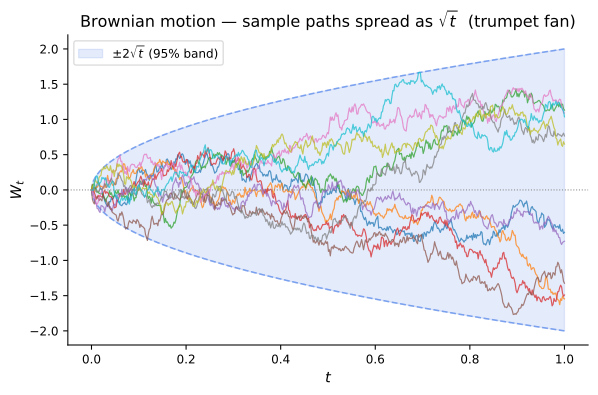
Multiple sample paths — the fan widens as \(\propto\sqrt{t}\):
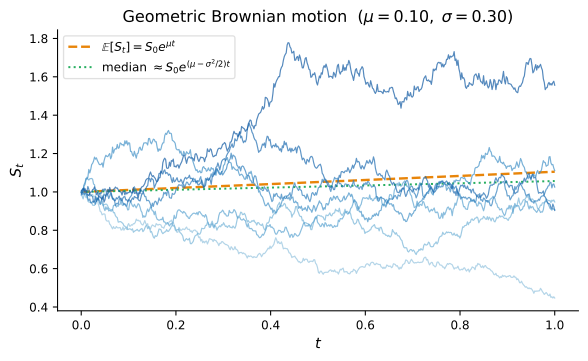
Example — Geometric BM: \(S_t = S_0 \exp\!\bigl((\mu-\tfrac12\sigma^2)t + \sigma W_t\bigr)\) is the Black-Scholes price model. Log-normal marginals; continuous, nowhere-differentiable paths:
2.2 Itō Calculus¶
2.2.0 Why You Cannot Use Ordinary Integration¶
Attempt to define \(\int_0^T W_t\,dW_t\) using a Riemann sum: pick \(W_{t_k}\) at the left endpoint → get one answer; pick \((W_{t_k}+W_{t_{k+1}})/2\) (midpoint) → get a different answer.
This ambiguity occurs because \(W\) is not of bounded variation. Itō’s convention (left endpoint) is the only one that produces a martingale — ensuring no look-ahead.
Definition — Itō Integral
For adapted \(f \in \mathcal{L}^2\) (i.e. \(\mathbb{E}\!\int_0^T f_t^2\,dt < \infty\)):
Key guarantees:
Zero mean: \(\mathbb{E}\!\left[\int_0^T f_t\,dW_t\right] = 0\).
Itō isometry: \(\mathbb{E}\!\left[\left(\int_0^T f_t\,dW_t\right)^2\right] = \mathbb{E}\!\int_0^T f_t^2\,dt\).
Martingale: \(M_t = \int_0^t f_s\,dW_s\) satisfies \(\mathbb{E}[M_t\mid\mathcal{F}_s]=M_s\).
Itō isometry — proof sketch:
Let \(I_T = \sum_k f_{t_k}\Delta W_k\) (simple process). Then:
For \(j \neq k\) (say \(j < k\)): \(f_{t_j}\Delta W_j\) and \(f_{t_k}\) are both \(\mathcal{F}_{t_k}\)-measurable, while \(\Delta W_k\) is independent of \(\mathcal{F}_{t_k}\) with mean 0 → cross term \(= 0\).
For \(j = k\): \(\mathbb{E}[f_{t_j}^2 (\Delta W_j)^2] = \mathbb{E}[f_{t_j}^2]\Delta t_j\) (independence of \(f_{t_j}\) and \(\Delta W_j\)).
2.2.1 Itō’s Lemma — Full Derivation¶
Theorem — Itō’s Lemma
For \(dX_t = \mu_t\,dt + \sigma_t\,dW_t\) and \(F \in C^{1,2}([0,T]\times\mathbb{R})\):
Expanded:
Derivation — Taylor expand \(F(t+dt, X_{t+dt})\):
Compute \((dX)^2\) using the Itō multiplication table:
× |
\(dt\) |
\(dW_t\) |
|---|---|---|
\(dt\) |
\(0\) |
\(0\) |
\(dW_t\) |
\(0\) |
\(dt\) |
Substituting:
The extra term \(\tfrac12\sigma^2\partial_{xx}F\,dt\) is the “Itō correction”.
In ordinary calculus \((dW)^2=0\), so it vanishes. In stochastic calculus, BM oscillates
so rapidly that \((dW)^2 = dt\) — a first-order effect.
Multidimensional version (for vector \(\mathbf{X}\in\mathbb{R}^n\), matrix noise):
where \(d[X_i, X_j]_t = d\langle X_i, X_j\rangle_t\) is the quadratic co-variation.
2.2.2 Worked Examples of Itō’s Lemma¶
Example 1 — GBM, derive explicit solution:
SDE: \(dS_t = \mu S_t\,dt + \sigma S_t\,dW_t\).
Goal: Find \(S_t\) in closed form.
Step 1 — Guess \(F(t,x) = \log x\). Compute partials: \(\partial_t F = 0\), \(\partial_x F = 1/x\), \(\partial_{xx}F = -1/x^2\).
Step 2 — Apply Itō’s lemma:
Step 3 — Integrate (deterministic integral + Itō integral):
Step 4 — Exponentiate:
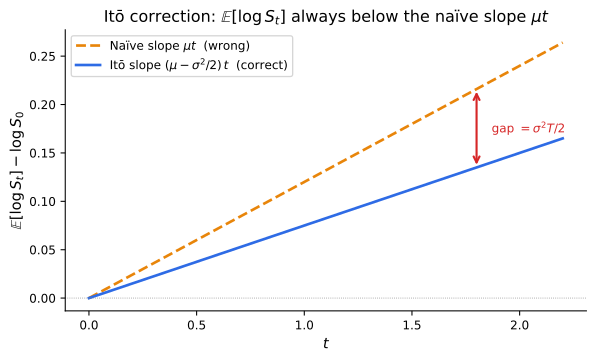
The Itō correction \(-\tfrac12\sigma^2 T\) lowers the expected log-return: \(\mathbb{E}[\log S_T] = \log S_0 + (\mu-\tfrac12\sigma^2)T\), but \(\mathbb{E}[S_T] = S_0 e^{\mu T}\) (Jensen’s inequality explains the gap: \(e^{\mathbb{E}[X]} < \mathbb{E}[e^X]\) for non-degenerate \(X\)).
Example 2 — Itō product rule (\(d(X_t Y_t)\)):
By Itō’s lemma applied to \(F(x,y) = xy\):
where \(d[X,Y]_t = \sigma_X\sigma_Y\,dt\). Compare to ordinary calculus: \(d(xy) = y\,dx + x\,dy\) (no cross term because \((dx)^2=0\)).
Example 3 — Integration by parts for stochastic integrals:
Ordinary calculus would give \(\int_0^T W_t\,dW_t = \tfrac12 W_T^2\). The \(-\tfrac12 T\) correction comes from the quadratic variation.
Verification via Itō’s lemma: Set \(F(t,x) = x^2/2\): \(dF = x\,dW + \tfrac12\cdot 1 \cdot dt = W_t\,dW_t + \tfrac12\,dt\). Integrate: \(\tfrac12 W_T^2 - 0 = \int_0^T W_t\,dW_t + \tfrac12 T\) → result follows. ✓
2.2.3 Itō vs Stratonovich¶
Property |
Itō integral |
Stratonovich integral (\(\circ\)) |
|---|---|---|
Chain rule |
Modified (\(+\tfrac12\sigma^2\partial_{xx}F\) term) |
Standard calculus chain rule |
Martingale |
Yes (if \(f\) adapted) |
No in general |
Use in finance |
Natural (no look-ahead) |
Physics, geometry |
Conversion |
\(\int f\circ dW = \int f\,dW + \tfrac12\int \partial_x f\,\sigma\,dt\) |
(same identity) |
SDE solutions |
Different numerics needed |
Standard ODE methods work |
Conversion formula — Itō \(\to\) Stratonovich:
Rule of thumb: Use Itō in finance (causality, no-arbitrage); use Stratonovich in physics/differential geometry (coordinate-invariant chain rule).
2.3 General Itō SDEs¶
2.3.0 Existence, Uniqueness and Picard Iteration¶
Theorem — Strong Solution Existence (Picard–Lindelöf for SDEs)
If \(b\) and \(\sigma\) are globally Lipschitz in \(x\) (uniformly in \(t\)): \(\|b(t,x)-b(t,y)\| + \|\sigma(t,x)-\sigma(t,y)\| \le L\|x-y\|\),
and satisfy linear growth: \(\|b(t,x)\|^2 + \|\sigma(t,x)\|^2 \le C^2(1+\|x\|^2)\),
then there exists a unique strong solution with \(\mathbb{E}\!\left[\sup_{t\le T}\|X_t\|^2\right] < \infty\).
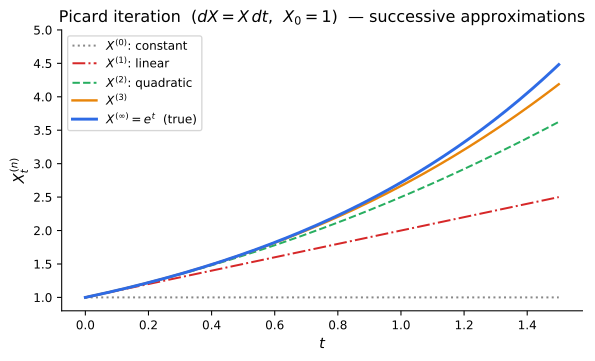
Picard iteration — construct the solution step by step:
Set \(X_t^{(0)} = x_0\) (constant). For \(n\ge 0\):
Intermediate step — bound the error:
Let \(\varepsilon_n(t) = \mathbb{E}\!\left[\sup_{s\le t}|X_s^{(n+1)}-X_s^{(n)}|^2\right]\).
By Doob’s \(L^2\)-inequality and Lipschitz:
By induction: \(\varepsilon_n(t) \le C \cdot \frac{(2L^2(T+1)t)^n}{n!} \to 0\). Geometric series → \(X^{(n)}\) is Cauchy in \(L^2\) → converges to the unique solution.
Intuition:
2.3.1 The Fokker-Planck Equation — How Densities Evolve¶
If \(X_t\) has density \(p(t,x)\), then \(p\) satisfies the Fokker-Planck (Kolmogorov forward) PDE:
Derivation sketch: For any test function \(\phi\):
using Itō’s lemma on \(\phi(X_t)\). Integration by parts in the \(x\)-integral transfers derivatives from \(\phi\) to \(p\), giving the Fokker-Planck equation.
Visual — density flows rightward (positive drift) and spreads (positive diffusion):
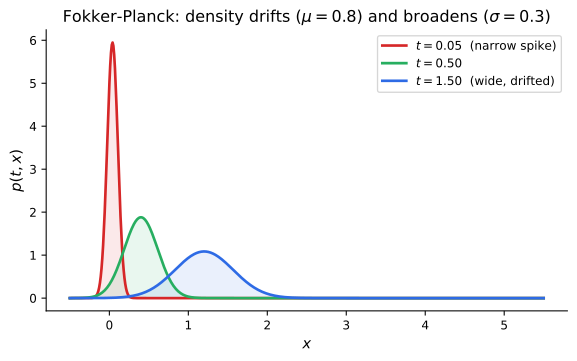
For OU: \(b = \kappa(\theta-x)\), \(\sigma\) = const → stationary solution \(p_\infty(x) = \mathcal{N}(\theta, \sigma^2/2\kappa)\).
2.3.2 Common SDE Reference Table¶
Process |
SDE |
Closed-form \(X_t\) |
Stationary dist. |
Use in Optimiz-rs |
|---|---|---|---|---|
Brownian motion |
\(dX = \sigma\,dW\) |
\(X_0 + \sigma W_t\) |
— |
Noise baseline |
Geometric BM |
\(dX = \mu X\,dt + \sigma X\,dW\) |
\(X_0 e^{(\mu-\sigma^2/2)t+\sigma W_t}\) |
Log-normal |
Price model |
Ornstein-Uhlenbeck |
\(dX = \kappa(\theta-X)\,dt + \sigma\,dW\) |
(see §2.4) |
\(\mathcal{N}(\theta, \sigma^2/2\kappa)\) |
Spread model |
CIR |
\(dX = \kappa(\theta-X)\,dt + \sigma\sqrt{X}\,dW\) |
(Bessel process) |
Gamma\((2\kappa\theta/\sigma^2, \sigma^2/2\kappa)\) |
Volatility, rates |
SABR |
\(dF = \sigma F^\beta dW^1\), \(d\sigma = \nu\sigma\,dW^2\) |
(no closed form) |
— |
Volatility model |
2.3.3 Numerical Schemes for SDEs¶
When no closed form exists, discretize with step \(\Delta t\):
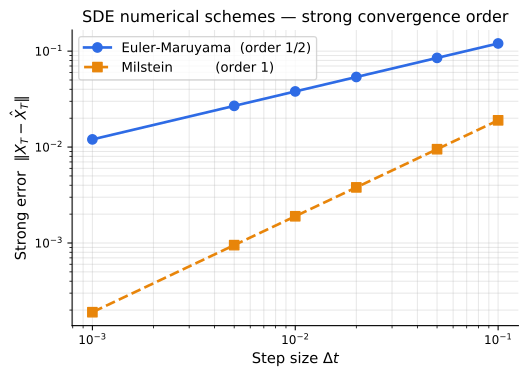
Euler-Maruyama (simplest, strong order 0.5):
where \(\Delta W_t = \sqrt{\Delta t}\,Z\), \(Z\sim\mathcal{N}(0,1)\).
Milstein (includes first-order Itō correction, strong order 1.0):
The extra term \(\tfrac12\sigma\sigma_x[(\Delta W_t)^2 - \Delta t]\) comes from applying Itō’s lemma to \(\sigma(X_t)dW_t\).
2.4 Ornstein-Uhlenbeck (Mean-Reversion)¶
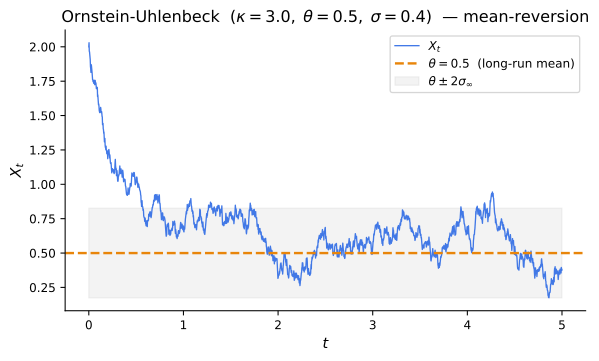
Used in Optimiz-rs’s sparse_mean_reversion and ou_estimator modules:
Intuition — restoring force: The drift is a spring pulling \(X_t\) back to \(\theta\):
2.4.1 Closed-Form Solution — Step by Step¶
Step 1 — Integrating factor. Rewrite the SDE as:
Multiply both sides by the integrating factor \(e^{\kappa t}\) and recognize the left-hand side:
(Here we used Itō’s product rule: \(d(e^{\kappa t}X_t) = e^{\kappa t}dX_t + X_t\cdot\kappa e^{\kappa t}dt\) — no quadratic variation cross term since \(e^{\kappa t}\) is deterministic.)
Step 2 — Integrate both sides from \(0\) to \(t\):
Step 3 — Divide by \(e^{\kappa t}\):
Interpretation of each term:
Term |
Meaning |
|---|---|
\(\theta\) |
Long-run equilibrium (the “anchor”) |
\((X_0-\theta)e^{-\kappa t}\) |
Deterministic decay: initial displacement shrinks at rate \(\kappa\) |
\(\sigma\int_0^t e^{-\kappa(t-s)}dW_s\) |
Stochastic part: weighted sum of all past noise shocks, with exponential forgetting |
The stochastic integral \(I_t = \sigma\int_0^t e^{-\kappa(t-s)}dW_s\) is a Gaussian random variable (linear functional of Brownian motion) with:
Step 4 — Marginal distribution:
As \(t\to\infty\): \(X_t \to \mathcal{N}(\theta, \sigma^2/2\kappa)\) — the stationary distribution.
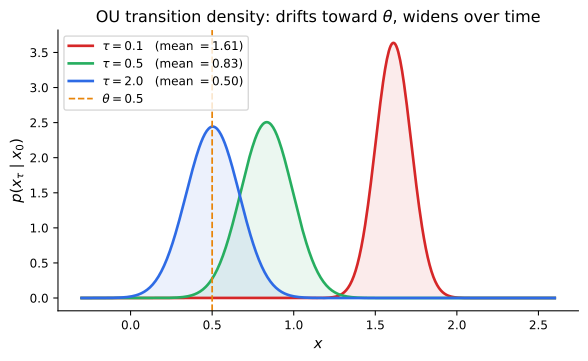
2.4.2 Transition Density (Conditional on \(X_s\))¶
This is exact (no approximation) because the OU process is linear. Key formulas:
2.4.3 Half-Life and Mean-Reversion Speed¶
Half-life: \(\tau_{1/2} = \ln 2/\kappa\) — time for the initial displacement to halve.
\(\kappa\) (per year) |
Half-life |
Typical use |
|---|---|---|
0.2 |
3.5 yr |
Long-term macro factors |
10 |
25 days |
Cross-sectional equity spreads |
55 |
4.6 days |
Short-term pair spreads |
252 |
1 trading day |
Intraday alpha signals |
MLE log-likelihood (discrete observations at spacing \(\Delta t\)):
where \(\hat\mu_i = \theta + (X_{t_{i-1}}-\theta)e^{-\kappa\Delta t}\) and \(\hat\sigma^2 = \frac{\sigma^2}{2\kappa}(1-e^{-2\kappa\Delta t})\).
Score equations (differentiate \(\ell\) and set to zero):
These are nonlinear in \(\kappa\); Optimiz-rs solves them with DE (ou_estimator::fit_mle()).
Example — Calibrating OU to an Equity-Pair Spread
Data: Daily log-spread \(X_t = \log(P_A / P_B)\) for a co-integrated pair, \(n=250\) observations, \(\Delta t=1/252\) years.
Step 1 — MLE: Maximize \(\ell(\kappa, \theta, \sigma)\) using ou_estimator::fit_mle().
Step 2 — Intermediate verification: The OU log-likelihood surface:
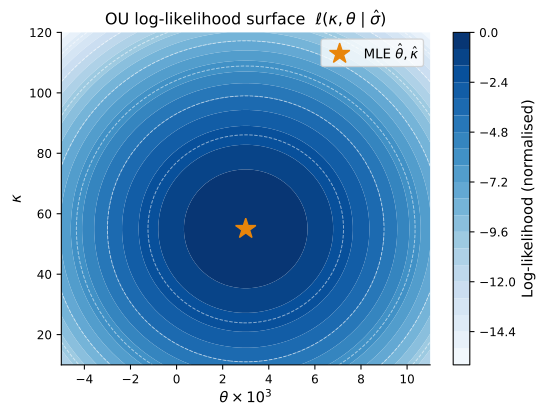
Typical results:
Parameter |
Estimate |
Interpretation |
|---|---|---|
\(\hat\kappa\) |
55/yr |
half-life approx 4.6 days |
\(\hat\theta\) |
0.003 |
long-run spread approx 0.3% |
\(\hat\sigma\) |
0.12/yr\(^{0.5}\) |
daily spread vol approx 0.75% |
Step 3 — Diagnostic:
Standardized residuals: \(r_i = (X_{t_i} - \hat\mu_i)/\hat\sigma\) should be \(\mathcal{N}(0,1)\).
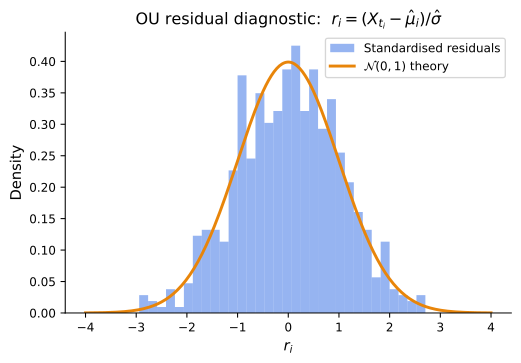
Ljung-Box test: checks for remaining autocorrelation in \(r_i\).
Step 4 — Trading signal: Enter when \(|X_t - \hat\theta| > 2\hat\sigma_\infty\) where \(\hat\sigma_\infty = \hat\sigma/\sqrt{2\hat\kappa}\). Exit at \(X_t = \hat\theta\). Expected holding time \(\approx \hat\tau_{1/2} = \ln 2/\hat\kappa \approx 4.6\) days.
P&L decomposition:
Gross expected profit per trade \(\approx 2\hat\sigma_\infty = 2\hat\sigma/\sqrt{2\hat\kappa}\).
Transaction costs must be \(< 2\hat\sigma_\infty\) for profitability.
3 · Jump Processes¶
Many financial time series exhibit sudden large moves that Brownian motion cannot capture.
3.1 Poisson Process¶
Definition — Poisson Process
A counting process \(N = (N_t)_{t\ge 0}\) is a Poisson process with intensity \(\lambda > 0\) if:
\(N_0 = 0\).
Independent, stationary increments.
\(\mathbb{P}(N_{t+h}-N_t=1) = \lambda h + o(h)\) and \(\mathbb{P}(\Delta N > 1) = o(h)\).
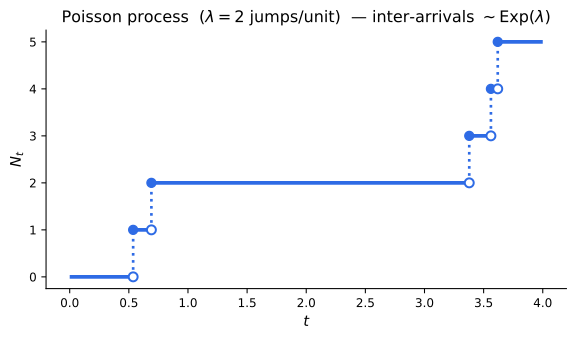
Equivalently, \(N_t \sim \text{Poisson}(\lambda t)\) and inter-arrival times are \(\text{Exp}(\lambda)\). The compensated process \(\tilde N_t = N_t - \lambda t\) is a martingale.
Sample path — step function with random jumps (\(\lambda=2\) per unit time):
3.2 Compound Poisson Jump-Diffusion (Merton 1976)¶
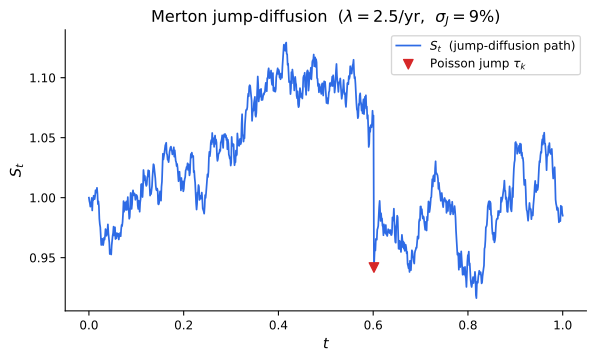
with \(N_t\) Poisson(\(\lambda\)) and \(J_k \sim \mathcal{N}(\mu_J, \sigma_J^2)\).
Sample path — smooth diffusion interrupted by sudden jumps:
Merton option price — Poisson mixture of Black-Scholes prices:
where \(\lambda' = \lambda e^{\mu_J+\frac12\sigma_J^2}\), \(r_n = r - \lambda(e^{\mu_J+\frac12\sigma_J^2}-1) + n(\mu_J+\tfrac12\sigma_J^2)/T\), and \(\sigma_n^2 = \sigma^2 + n\sigma_J^2/T\).
Intuition: Condition on exactly \(n\) jumps occurring (probability \(e^{-\lambda' T}(\lambda' T)^n/n!\)). In that scenario the world is a BS world with adjusted drift \(r_n\) and total variance \(\sigma^2 T + n\sigma_J^2\). Average over the Poisson distribution of \(n\).
Example — Fitting Merton to a Crash Event
Observed: S&P 500, March 2020. Implied vol surface shows a vol smile — OTM puts are expensive (fat left tail), which pure BS cannot explain.
Merton calibration (4 parameters: \(\sigma, \lambda, \mu_J, \sigma_J\)):
Parameter |
Estimated value |
Interpretation |
|---|---|---|
\(\sigma\) |
0.18/yr |
baseline diffusion vol |
\(\lambda\) |
3/yr |
approx 3 crash events per year |
\(\mu_J\) |
-0.12 |
average log-jump = -12% |
\(\sigma_J\) |
0.08 |
jump size std = 8% |
Fitting procedure:
Collect implied vols for strikes \(K\) and maturities \(T\).
Minimise \(\sum_{K,T}(C_{\text{Merton}}(K,T;\theta) - C_{\text{market}})^2\) via
differential_evolution(DE is ideal — 4 params, non-convex landscape).Diagnostic: Plot Merton vs market smile; expect fit within 0.5 vega.
Result: Negative \(\mu_J\) captures left-tail skew, explaining costly OTM puts.
3.3 Levy Processes and the Levy-Khintchine Representation¶
Theorem — Levy-Khintchine
Every Levy process (independent stationary increments) has characteristic function
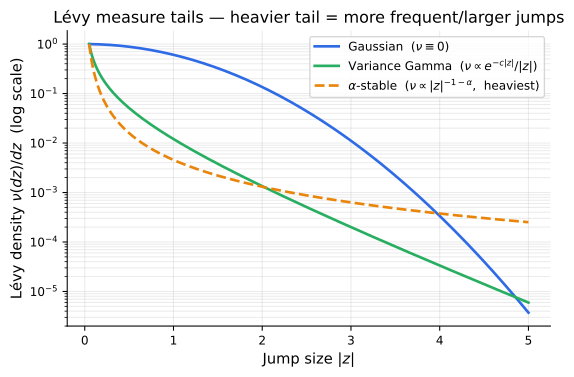
where \((b, \sigma^2, \nu)\) is the Levy triplet and \(\nu\) the Levy measure, satisfying \(\int(1\wedge z^2)\nu(dz)<\infty\).
Levy measure tail shapes:
Levy Process Zoo
Process |
Levy measure \(\nu\) |
Use case |
|---|---|---|
Brownian motion |
\(\nu=0\) |
continuous diffusion |
Compound Poisson |
finite measure |
rare large jumps |
Variance Gamma |
$\nu(dz)\propto e^{-c |
z |
CGMY |
power-law with exponential cutoff |
heavy tails, \(Y\in(0,2)\) |
\(\alpha\)-stable |
$c |
z |
3.4 SDEs with Jumps — Generator and Ito Formula¶
where \(\tilde N(dt,dz) = N(dt,dz) - \nu(dz)\,dt\) is the compensated jump measure.
Ito formula for jump-diffusions:
where the generator is
4 · Optimal Control (HJB, PMP, Jumps)¶
Big picture. Optimal control asks: given a stochastic system we can steer with a control \(u_t\), what policy minimises expected cost? Three complementary tools answer this:
Tool |
Solves |
Scales to |
Intuition |
|---|---|---|---|
HJB PDE |
Value function \(V(t,x)\) |
Low dim (PDE grid) |
Dynamic programming |
PMP |
Optimal paths \((X_t,p_t)\) |
High dim (ODE) |
Adjoint sensitivity |
HJBI |
Same as HJB + jumps |
Low dim |
Non-local integral term |
4.1 Stochastic HJB¶
Setup. The state \(X_t \in \mathbb{R}^d\) evolves as
and we minimise the total expected cost
The value function \(V(t,x) = \inf_u J(t,x;u)\) satisfies:
Intuition — three terms inside the infimum:
\(\ell(x,u)\) — instantaneous running cost (pay now).
\(\nabla_x V^\top b\) — drift of the value function (first-order Taylor in state change).
\(\tfrac12\operatorname{Tr}(\sigma\sigma^\top\nabla^2 V)\) — curvature correction due to noise (stochastic analogue of the second-order Taylor term).
Under smooth \(V\), the feedback law is \(u^\star(t,x) = \arg\min_u[\ell(x,u)+\nabla_x V^\top b(x,u)].\)
Example — Optimal Portfolio Allocation (Merton 1969)
Investor wealth \(X_t\) follows \(dX_t = (r + u_t(\mu-r))X_t\,dt + u_t\sigma X_t\,dW_t\), where \(u_t\in\mathbb{R}\) is the fraction invested in the risky asset.
Minimise \(-\mathbb{E}[\log X_T]\) (maximise expected log-utility).
Ansatz: \(V(t,x) = \ln x + f(t)\). Substituting into HJB:
The optimal Merton rule is constant:
Invest a fixed fraction proportional to the Sharpe ratio, inversely to variance — independent of wealth and time.
LQR special case (\(\ell = x^\top Q x + u^\top R u\), \(b=Ax+Bu\), \(\sigma\) constant): \(V(t,x)=x^\top P(t)x + v(t)\) with \(P\) solving the matrix Riccati ODE:
The optimal control is linear feedback: \(u^\star_t = -R^{-1}B^\top P(t)X_t\).
Example — Optimal Inventory (Almgren-Chriss liquidation)
Liquidate \(X_0\) shares by time \(T\). Inventory \(X_t\), trading rate \(u_t<0\):
This is a deterministic LQR with \(A=0\), \(B=1\), \(Q=\alpha\), \(R=\beta\). The Riccati solution gives the TWAP-like schedule
Large \(\kappa\) (high risk aversion or low impact cost) -> aggressive front-loaded selling.
4.2 Pontryagin Maximum Principle¶
The PMP avoids the curse of dimensionality — it converts HJB into a two-point boundary-value ODE in \((X_t, p_t)\), feasible when a PDE grid is intractable.
Theorem (PMP)
Define the Hamiltonian \(\mathcal{H}(x,u,p) = \ell(x,u)+p^\top b(x,u)\). If \((X^\star, u^\star)\) is optimal, there exists a costate process \(p_t\) with:
and the optimality condition \(u_t^\star = \arg\min_u \mathcal{H}(X_t^\star, u, p_t)\) holds a.e.
Costate intuition. \(p_t\) is the shadow price of state \(X_t\):
This is exactly the adjoint / backpropagation equation of deep learning — PMP is the continuous-time version of gradient backpropagation through a dynamical system.
Algorithm (shooting method):
1. Guess costate p_0
2. Integrate forward:  dX = b(X, u*(X,p)) dt           (state ODE)
3. Integrate backward: dp = -grad_x H(X, u*, p) dt     (costate ODE)
4. Check boundary condition:  p_T = grad g(X_T)
5. If not satisfied -> update p_0 (Newton / gradient) -> go to 2
Example — PMP for the Merton Problem
With \(\ell = 0\), \(g(x) = -\ln x\), \(b = (r+u(\mu-r))x\), the Hamiltonian is \(\mathcal{H}(x,u,p) = p(r+u(\mu-r))x\).
Costate ODE: \(\dot p_t = -\partial_x \mathcal{H} = -p_t(r+u^\star(\mu-r))\), with terminal \(p_T = -1/X_T^\star\).
Optimality condition \(\partial_u\mathcal{H}=0\) recovers \(u^\star = (\mu-r)/\sigma^2\).
The costate path \(p_t = -e^{-(T-t)(r+(\mu-r)u^\star)}/X_t^\star\) confirms that the shadow price scales inversely with wealth — poorer investors value state more.
The costate pair \((X_t^\star, p_t)\) moves along Hamiltonian geodesics on \(T^\star\mathbb{R}^d\) — a direct link to symplectic geometry (§10.4).
4.3 HJB with Jumps (HJBI)¶
When the state can jump (§3.4), the HJB equation gains a non-local integral operator:
Intuition for the integral term. A jump of size \(c\) moves the state from \(x\) to \(x+c\), changing the value function by \(V(x+c)-V(x)\). The compensator \(\nabla V^\top c\) subtracts the linear part already counted in the drift.
The optimal_control module discretises the integral on truncated support using Gaussian quadrature.
Example — Optimal Execution with Jump Risk
Extend the inventory model with Poisson order-flow shocks:
With Gaussian jumps, the HJBI reduces to the same LQR Riccati ODE but with effective diffusion \(\sigma_{\text{eff}}^2 = \lambda\sigma_J^2\).
Key insight: order-flow risk acts like additional Brownian volatility, accelerating the optimal sell schedule.
4.4 Viscosity Solutions¶
When \(V\) fails to be \(C^{1,2}\) — degenerate diffusion, constraints, or non-smooth terminal conditions — classical solutions may not exist. Viscosity solutions (Crandall-Lions 1983) provide a rigorous weak notion that restores existence and uniqueness.
Definition — Viscosity Subsolution
A continuous \(V\) is a viscosity subsolution if for every smooth \(\phi\) touching \(V\) from above at \((t_0,x_0)\):
A supersolution reverses the inequality. The unique viscosity solution is both.
Practical interpretation: Classical: “\(V\) satisfies the PDE pointwise.” Viscosity: “\(V\) satisfies the PDE in an averaged sense — even at kinks.”
Optimiz-rs’s backward DP converges to the viscosity solution under CFL: \(\Delta t \le C\,(\Delta x)^2\).
Example — American Option as a Viscosity Problem
American put payoff \(g(x) = (K-x)^+\) gives the variational inequality:
Continuation region (\(V > g\)): Black-Scholes PDE holds.
Exercise region (\(V = g\)): option exercised immediately.
At the free boundary: \(\partial_x V\) is continuous (smooth-pasting) but \(\partial_{xx}V\) is not — \(V\) is \(C^1\) but not \(C^2\). Viscosity theory handles this kink rigorously.
Backward DP grid schema:
t=T    [ g(x_1)  g(x_2)  ...  g(x_n) ]   terminal condition
t=T-1  [ V^1     V^2     ...  V^n    ]   one backward step
 .
 .
t=0    [ V_0^1   V_0^2   ...  V_0^n  ]  -> optimal policy u*(x,0)
5 · Mean Field Games (1D Solver)¶
MFG couples a backward HJB (individual value) with a forward Fokker-Planck (population density):
Coupling: \(H\) depends on \(m\) (mean-field interaction), creating a fixed-point problem.
Backward-forward information flow:
t = 0                                t = T
  m_0 (known)                          g(x) (known)
    |                                    |
    |  Fokker-Planck (forward -->)        |
    |  evolves population density m       |
    |                                    |
    v                                    v
  m(t,x)  <----- mutually consistent ---  u(t,x)
                HJB (backward <--)
                optimal value function

  Each agent uses u to choose optimal control.
  Population density m feeds back into u via H(x, du, m).
  Fixed point: m and u are simultaneously consistent (Nash equilibrium).
Fixed-point algorithm:
1. Initialise m^0 = m_0  (e.g. Gaussian)
2. Solve HJB backward  -> u^{k+1}
3. Extract optimal drift: alpha*(x,t) = -d_p H(x, d_x u^{k+1}, m^k)
4. Solve Fokker-Planck forward with alpha* -> m^{k+1}
5. Check ||m^{k+1} - m^k||_1 < eps; if not, k++ -> go to 2
Before observation (predict): After observation (update):
+——————+ +——–+ | | | | | p(x | y_1:t-1) | —-> |p(x|y_t)| | wide ellipse | | tight | +——————+ +——–+
Kalman gain K interpolates between: K -> 0 (huge R, ignore y_t) => x_hat = prior K -> H^-1 (R=0, trust y_t) => x_hat = H^-1 y_t
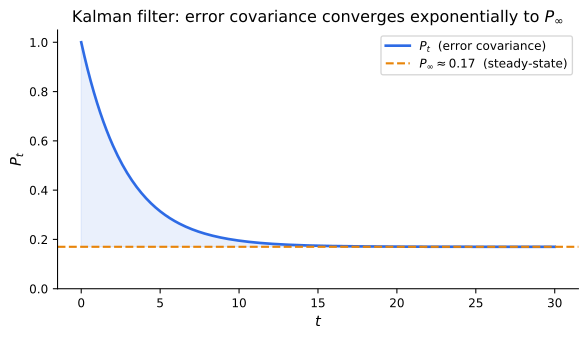
Covariance convergence: \(P_t \to P_\infty\) (algebraic Riccati solution) exponentially fast when \((F,H)\) is observable.
6.2 Information-Theoretic View¶
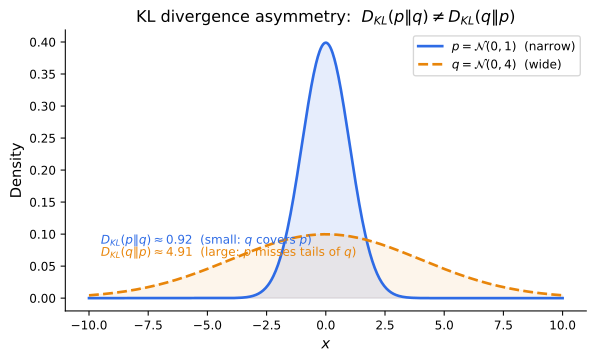
The Kalman filter computes the exact conditional mean \(\hat{\mathbf{x}}_t = \mathbb{E}[\mathbf{x}_t \mid \mathbf{y}_{1:t}]\) in Gaussian models and minimises \(D_{\mathrm{KL}}(p(\mathbf{x}_t|\mathbf{y}_{1:t})\,\|\,\mathcal{N}(\hat{\mathbf{x}}_t, P_t))\) over all Gaussian approximations.
6.3 Continuous-Time Limit (Kalman-Bucy)¶
For \(d\mathbf{X}_t = A\mathbf{X}_t\,dt + B\,d\mathbf{W}_t\), \(d\mathbf{Y}_t = C\mathbf{X}_t\,dt + d\mathbf{V}_t\), the error covariance satisfies the Riccati ODE:
Example — Tracking a Noisy AR(1) Signal
Model: Latent trend \(x_t = 0.95 x_{t-1} + w_t\) (\(Q=0.01\)); noisy observation \(y_t = x_t + v_t\) (\(R=1.0\)).
Steady-state: \(P_\infty \approx 0.17\), so \(K_\infty \approx 0.15\). Kalman weights the new observation at 15%, prior at 85%.
Implication: With \(R/Q = 100\) (much noisier obs than process), the filter heavily smooths observations — useful for noisy financial signals like tick prices.
7 · MCMC (Metropolis-Hastings and Langevin)¶
7.1 Metropolis-Hastings¶
For target \(\pi(x) \propto e^{-U(x)}\) and proposal \(q(x'\mid x)\):
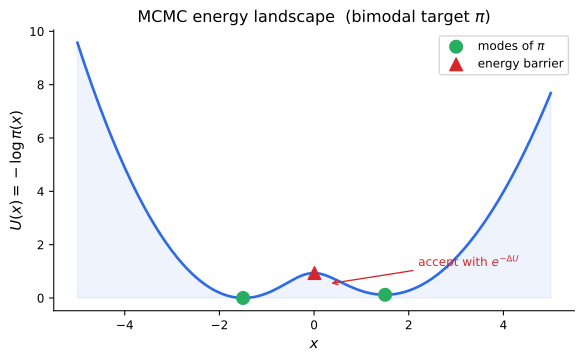
Detailed balance \(\pi(x)\alpha(x\to x') = \pi(x')\alpha(x'\to x)\) ensures \(\pi\) is the unique stationary distribution.
Optimal scaling: With Gaussian proposal, step \(h^\star \approx 2.38/\sqrt{d}\) (Roberts-Gelman-Gilks 1997) targets ~23-45% acceptance.
Energy landscape and accept/reject:
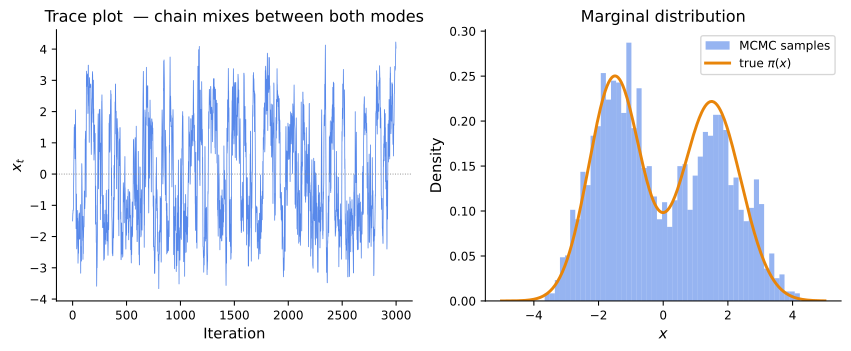
Trace plot of a well-mixed chain:
7.2 Langevin Dynamics (MALA)¶
Metropolis-Adjusted Langevin proposal:
a discretisation of the overdamped Langevin SDE:
whose stationary distribution is exactly \(\pi \propto e^{-U}\).
MALA converges in \(O(d^{1/3})\) steps vs \(O(d)\) for RW-MH — key advantage for high-dimensional posteriors.
MALA vs RW-MH trajectory comparison:
  RW-MH vs MALA trajectories
  ┄┄┄┄┄┄┄┄┄┄┄┄┄┄┄┄┄┄┄┄┄┄┄┄┄┄┄┄┄┄┄┄┄┄┄┄┄┄┄┄┄┄┄┄

  RW-MH (random walk):          MALA (gradient-guided):

  ◦  ◦  ◦                         ▲ −∇U ← toward mode
   ◦  ◦  ◦  ◦      vs             ╱
      ◦  ◦                       ◦ ╱ ◦  ◦
   ◦     ◦  ◦                     ◦     ◦

  diffusive, O(d) steps            directed, O(d^{1/3}) steps
  each step ∼ isotropic ξ          each step biased by −∇U(x)
Example — Calibrating OU Parameters via MCMC
Goal: Full Bayesian inference on \((\kappa, \theta, \sigma)\) of an OU process. Prior: \(\kappa \sim \text{Gamma}(2,0.1)\), \(\theta \sim \mathcal{N}(0,1)\), \(\sigma \sim \text{HalfNormal}(0.5)\).
MALA chain (\(d=3\), step \(h=0.02\)):
Iteration  kappa   theta   sigma   log-post
---------  -----   -----   -----   --------
  1000      42.1   0.003   0.11     125.3
  2000      55.3   0.003   0.12     128.7   <- burn-in complete
  3000      58.1   0.003   0.12     129.2
 50000      54.8   0.003   0.12     128.9   <- stable posterior
Marginal posterior (kappa): 95% CI \([44, 67]\), peak at 55/yr — wider than the MLE point estimate, reflecting genuine parameter uncertainty.
Quick Reference¶
Concept |
Key equation / object |
Optimiz-rs module |
|---|---|---|
Brownian motion |
\(W_t - W_s \sim \mathcal{N}(0,t-s)\) |
|
Ito SDE |
\(dX=b\,dt+\sigma\,dW\) |
|
Poisson / Compound Poisson |
\(N_t\sim\text{Poisson}(\lambda t)\) |
|
Levy process |
triplet \((b,\sigma^2,\nu)\) |
|
HJB PDE |
\(-\partial_t V = \inf_u[\ell + \nabla V^\top b + \tfrac12\operatorname{Tr}\sigma\sigma^\top\nabla^2 V]\) |
|
HJBI (jumps) |
\(+\int[V(\cdot+c)-V-\nabla V^\top c]\nu\,dz\) |
|
PMP costate |
\(\dot p = -\nabla_x\mathcal{H}\), \(u^\star=\arg\min_u\mathcal{H}\) |
|
MFG (HJB + KFP) |
fixed-point \(u,m\) |
|
Kalman filter |
\(K_t = P^-H^\top(HP^-H^\top+R)^{-1}\) |
|
MALA |
\(x'=x-\tfrac{h^2}{2}\nabla U+h\xi\) |
|
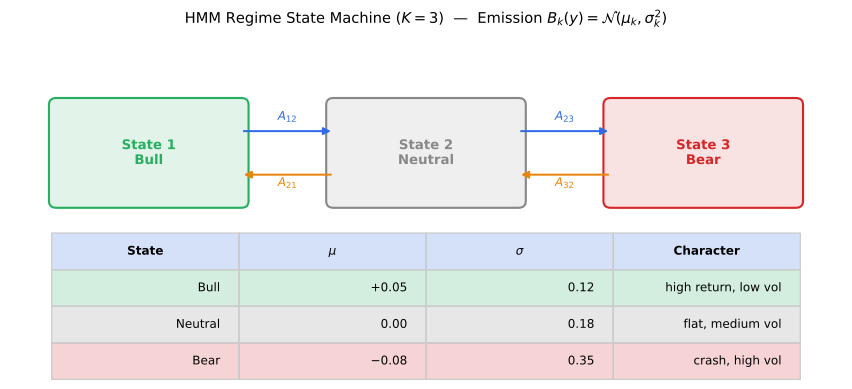
HMM |
Baum-Welch EM + Viterbi |
|
Fisher information |
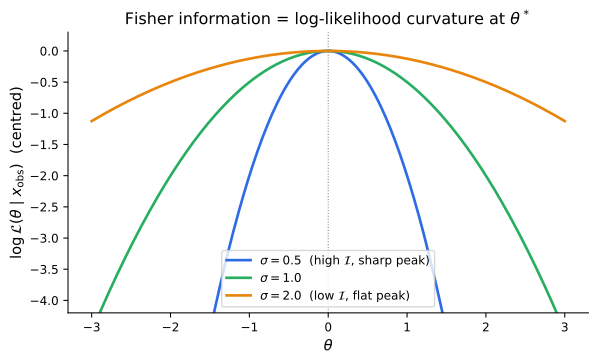
\(\mathcal{I}_{ij}=\mathbb{E}[\partial_i\ell\,\partial_j\ell]\) |
|
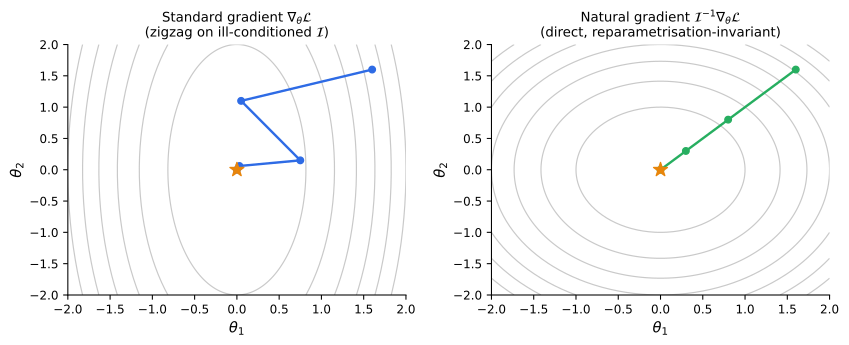
Natural gradient |
\(\mathcal{I}^{-1}\nabla_\theta\mathcal{L}\) |
|
Riemannian / Lie geometry |
Christoffel symbols, Lie-Poisson equations |
experimental |
DE (jDE) |
mutation + crossover + selection |
|
References¶
Oksendal, B. Stochastic Differential Equations, 6th ed. Springer, 2003.
Cont, R. & Tankov, P. Financial Modelling with Jump Processes. CRC Press, 2004.
Fleming, W.H. & Soner, H.M. Controlled Markov Processes and Viscosity Solutions. Springer, 2006.
Lasry, J.-M. & Lions, P.-L. “Mean field games.” Jpn. J. Math. 2 (2007) 229-260.
Amari, S. Information Geometry and Its Applications. Springer, 2016.
do Carmo, M.P. Riemannian Geometry. Birkhauser, 1992.
Holm, D.D., Marsden, J.E. & Ratiu, T.S. “The Euler-Poincare equations.” Adv. Math. 137 (1998).
Price, K.V., Storn, R.M. & Lampinen, J.A. Differential Evolution. Springer, 2005.
Roberts, G.O., Gelman, A. & Gilks, W.R. “Weak convergence of Metropolis algorithms.” (1997).
Merton, R.C. “Option pricing when underlying stock returns are discontinuous.” JFE 3 (1976).
Crandall, M.G. & Lions, P.-L. “Viscosity solutions of Hamilton-Jacobi equations.” Trans. AMS (1983).
Almgren, R. & Chriss, N. “Optimal execution of portfolio transactions.” J. Risk 3 (2001).
Carmona, R. & Delarue, F. Probabilistic Theory of Mean Field Games. Springer, 2018.