Optimal Control
This module provides advanced optimal control algorithms for financial applications, including Hamilton-Jacobi-Bellman (HJB) equation solvers, regime-switching models, parameter estimation, and state-space filtering. All algorithms are implemented in high-performance Rust with Python bindings.
Mathematical Foundations
Hamilton-Jacobi-Bellman (HJB) Equation
The HJB equation is a fundamental result in optimal control theory that provides the necessary and sufficient conditions for optimality of a control policy. For a stochastic control problem:
where \(V(x)\) is the value function, \(\rho\) is the discount rate, \(L\) is the running cost, and \(X_t\) follows a controlled stochastic process. The HJB equation is:
where \(\mathcal{L}^\alpha\) is the infinitesimal generator of the controlled process.
Application to Mean-Reverting Spreads
For pairs trading with an Ornstein-Uhlenbeck (OU) spread process:
with transaction costs \(c > 0\), the HJB equation becomes:
The optimal control is a threshold policy: buy when \(x < x_L\), sell when \(x > x_U\), hold otherwise.
Viscosity Solutions
Classical solutions to HJB equations rarely exist due to:
Non-smoothness at boundaries: The value function \(V(x)\) has kinks where the optimal control switches
Lack of regularity: Second derivatives \(V''(x)\) may not exist everywhere
Free boundary problems: The optimal switching thresholds \((x_L, x_U)\) are unknown
Viscosity solutions generalize the notion of solution to allow for non-smooth value functions. A function \(V\) is a viscosity solution if:
Subsolution property: For any smooth test function \(\phi\) such that \(V - \phi\) has a local maximum at \(x_0\): $\(\rho V(x_0) \leq \mathcal{H}(x_0, V(x_0), D\phi(x_0), D^2\phi(x_0))\)$
Supersolution property: For any smooth test function \(\psi\) such that \(V - \psi\) has a local minimum at \(x_0\): $\(\rho V(x_0) \geq \mathcal{H}(x_0, V(x_0), D\psi(x_0), D^2\psi(x_0))\)$
where \(\mathcal{H}\) is the Hamiltonian.
Key properties:
Uniqueness: Under suitable conditions (coercivity, proper discount), the viscosity solution is unique
Stability: Viscosity solutions are stable under uniform convergence
Numerical convergence: Monotone finite difference schemes converge to the viscosity solution
Finite Difference Methods
We discretize the HJB equation on a spatial grid \(x_i = x_{\min} + ih\), \(i = 0, \ldots, N\), with grid spacing \(h\).
Upwind Schemes
For the OU drift term \(\kappa(\theta - x)V'(x)\), we use upwind finite differences to ensure monotonicity and stability:
If \(\kappa(\theta - x_i) > 0\) (rightward drift): use forward difference $\(V'(x_i) \approx \frac{V_{i+1} - V_i}{h}\)$
If \(\kappa(\theta - x_i) < 0\) (leftward drift): use backward difference $\(V'(x_i) \approx \frac{V_i - V_{i-1}}{h}\)$
The diffusion term uses centered differences: $\(V''(x_i) \approx \frac{V_{i+1} - 2V_i + V_{i-1}}{h^2}\)$
Policy Iteration Algorithm
The HJB equation with control is solved via policy iteration:
Initialize: Start with policy \(\alpha^{(0)}\) (e.g., always hold)
Policy evaluation: Solve the linear system for value function \(V^{(k)}\): $\(\rho V^{(k)}_i = \mathcal{L}^{\alpha^{(k)}} V^{(k)}_i + L(x_i, \alpha^{(k)}_i)\)$
Policy improvement: Update policy by maximizing Hamiltonian: $\(\alpha^{(k+1)}_i = \arg\max_{\alpha} \{ \mathcal{L}^\alpha V^{(k)}_i + L(x_i, \alpha) \}\)$
Convergence check: If \(\|\alpha^{(k+1)} - \alpha^{(k)}\|_\infty < \epsilon\), stop; otherwise return to step 2
Convergence properties:
Typically 10-50 iterations for practical problems
Geometric convergence rate
Numerical solution converges to viscosity solution as \(h \to 0\)
Implemented Algorithms
1. HJB Solver for OU Process
Solves the optimal switching problem for mean-reverting spreads with transaction costs.
Implementation: src/optimal_control/hjb_solver.rs
Python API:
from optimizr import solve_hjb_py, solve_hjb_full_py

# Basic solver - returns optimal thresholds
lower, upper, residual, iters = solve_hjb_py(
    kappa=3.0,           # Mean reversion speed
    theta=0.0,           # Long-run mean
    sigma=0.2,           # Volatility
    rho=0.04,            # Discount rate
    transaction_cost=0.001,  # Transaction cost per trade
    n_points=400,        # Number of grid points
    max_iter=4000,       # Maximum policy iterations
    tolerance=1e-7,      # Convergence tolerance
    n_std=5.0,          # Grid extent in standard deviations
)

print(f"Optimal bounds: ({lower:.3f}, {upper:.3f})")
print(f"Residual: {residual:.2e}, Iterations: {iters}")

# Full solver - also returns value function and derivatives
lower, upper, residual, iters, V, V_x, V_xx = solve_hjb_full_py(
    kappa=3.0, theta=0.0, sigma=0.2, rho=0.04,
    transaction_cost=0.001, n_points=400
)

# Plot value function derivatives for diagnostics
import matplotlib.pyplot as plt
plt.plot(V_x)
plt.axvline(lower, color='r', linestyle='--', label='Lower bound')
plt.axvline(upper, color='g', linestyle='--', label='Upper bound')
plt.legend()
plt.title("Value function derivative V'(x)")
Parameters:
kappa: Mean reversion speed (typical range: 0.1-10). Higher values → faster reversion → narrower bandstheta: Long-run mean (typically 0 for normalized spreads)sigma: Volatility (typical range: 0.1-1.0). Higher values → wider bandsrho: Discount rate (typical: 0.01-0.1). Higher values → more myopic strategytransaction_cost: Per-trade cost (typical: 0.0001-0.01). Higher values → wider bands, fewer tradesn_points: Grid resolution (recommended: 200-500). Higher → more accurate but slowern_std: Grid extent (recommended: 3-6). Should cover 99%+ of spread distribution
Returns:
lower: Optimal buy threshold (negative value)upper: Optimal sell threshold (positive value)residual: Maximum policy change in last iteration (should be < tolerance)iters: Number of policy iterations (typically 10-50)V,V_x,V_xx: (full solver only) Value function and derivatives on grid
When to use:
Pairs trading with mean-reverting spreads
Statistical arbitrage with transaction costs
Optimal entry/exit for mean-reverting assets
Requires reliable OU parameter estimates (see OU estimation below)
Diagnostics:
Plot \(V'(x)\) to check smoothness near thresholds
Verify
residual < tolerancefor convergenceCheck that thresholds are within grid bounds
If not converged: increase
max_iteror adjust grid parameters
2. Viscosity Solution Solver
General-purpose viscosity solution solver for HJB equations with arbitrary Hamiltonians.
Implementation: src/optimal_control/viscosity.rs
Usage: Advanced users can extend this for custom control problems beyond OU switching.
3. Regime Switching Models
Optimal control with multiple market regimes, each with different dynamics.
Implementation: src/optimal_control/regime_switching.rs
Approach:
Use HMM to identify hidden regimes (see HMM section)
Estimate OU parameters per regime
Solve HJB per regime to get regime-specific thresholds
Switch control policy based on decoded regime
Example workflow:
from optimizr import HMM, estimate_ou_params_py, solve_hjb_py
import numpy as np

# Step 1: Train HMM on spread returns
returns = np.diff(spread)
hmm = HMM(n_states=2)
hmm.fit(returns.reshape(-1, 1), n_iterations=100)
regimes = hmm.predict(returns.reshape(-1, 1))

# Step 2: Estimate OU parameters per regime
params = []
for regime_id in range(2):
    mask = (regimes == regime_id)
    spread_regime = spread[1:][mask]  # Align with returns
    kappa, theta, sigma, half_life = estimate_ou_params_py(
        spread_regime, dt=1/252
    )
    params.append((kappa, theta, sigma))
    print(f"Regime {regime_id}: κ={kappa:.2f}, θ={theta:.3f}, σ={sigma:.3f}")

# Step 3: Solve HJB per regime
thresholds = []
for kappa, theta, sigma in params:
    lower, upper, _, _ = solve_hjb_py(
        kappa=kappa, theta=theta, sigma=sigma,
        rho=0.04, transaction_cost=0.001
    )
    thresholds.append((lower, upper))
    print(f"Thresholds: ({lower:.3f}, {upper:.3f})")

# Step 4: Apply regime-specific control
current_regime = regimes[-1]
lower, upper = thresholds[current_regime]
if spread[-1] < lower:
    action = "BUY"
elif spread[-1] > upper:
    action = "SELL"
else:
    action = "HOLD"
print(f"Current regime: {current_regime}, Action: {action}")
4. Jump Diffusion Models
Extension of OU process with Poisson jumps for modeling sudden price shocks.
Implementation: src/optimal_control/jump_diffusion.rs
Model: $\( dX_t = \kappa(\theta - X_t)dt + \sigma dW_t + J_t dN_t \)$
where \(N_t\) is a Poisson process with intensity \(\lambda\), and \(J_t \sim \mathcal{N}(\mu_J, \sigma_J^2)\) are jump sizes.
Use case: Markets with flash crashes, earnings announcements, or other discontinuous events.
5. Multi-Regime Switching Jump Diffusion (MRSJD)
Combines regime switching with jump diffusion for maximum flexibility.
Implementation: src/optimal_control/mrsjd.rs
Model: Each regime has its own OU parameters AND jump process parameters.
Use case: Complex markets with both regime changes and sudden shocks (e.g., crypto, emerging markets).
6. OU Parameter Estimation
Estimates Ornstein-Uhlenbeck process parameters from time series data.
Implementation: src/optimal_control/ou_estimator.rs
Python API:
from optimizr import estimate_ou_params_py
import numpy as np
import matplotlib.pyplot as plt

# Simulate OU process (for testing)
dt = 1/252  # Daily data
T = 1000
kappa_true, theta_true, sigma_true = 3.0, 0.0, 0.2
rng = np.random.default_rng(0)
spread = [0.0]
for _ in range(T-1):
    dx = kappa_true * (theta_true - spread[-1]) * dt + \
         sigma_true * np.sqrt(dt) * rng.standard_normal()
    spread.append(spread[-1] + dx)

spread = np.array(spread)

# Estimate parameters
kappa, theta, sigma, half_life = estimate_ou_params_py(spread, dt=dt)

print(f"True:      κ={kappa_true:.2f}, θ={theta_true:.3f}, σ={sigma_true:.3f}")
print(f"Estimated: κ={kappa:.2f}, θ={theta:.3f}, σ={sigma:.3f}")
print(f"Half-life: {half_life:.1f} periods ({half_life*252:.1f} days)")

# Visualise the simulated path together with the estimated mean-reversion
# level and the decay envelope implied by the fitted half-life.
t_axis = np.arange(len(spread)) * dt * 252  # in days
fig, axes = plt.subplots(1, 2, figsize=(11, 4))
axes[0].plot(t_axis, spread, lw=0.7, label="simulated path")
axes[0].axhline(theta_true, color="k", ls=":", label="true θ")
axes[0].axhline(theta, color="red", ls="--", label="estimated θ")
axes[0].set_xlabel("days"); axes[0].set_ylabel("spread")
axes[0].set_title("OU simulation vs estimated long-run mean")
axes[0].legend(); axes[0].grid(alpha=0.3)

# Empirical autocorrelation vs theoretical exp(-κ τ).
lags = np.arange(0, 60)
x = spread - spread.mean()
acf = np.array([
    (x[: len(x) - k] @ x[k:]) / (x @ x) for k in lags
])
axes[1].plot(lags, acf, "o-", label="empirical ACF")
axes[1].plot(lags, np.exp(-kappa * lags * dt), "--",
             label=r"theoretical $e^{-\kappa\,\tau}$")
axes[1].set_xlabel("lag (days)"); axes[1].set_ylabel("autocorrelation")
axes[1].set_title("Mean-reversion fingerprint")
axes[1].legend(); axes[1].grid(alpha=0.3)
fig.tight_layout(); plt.show()
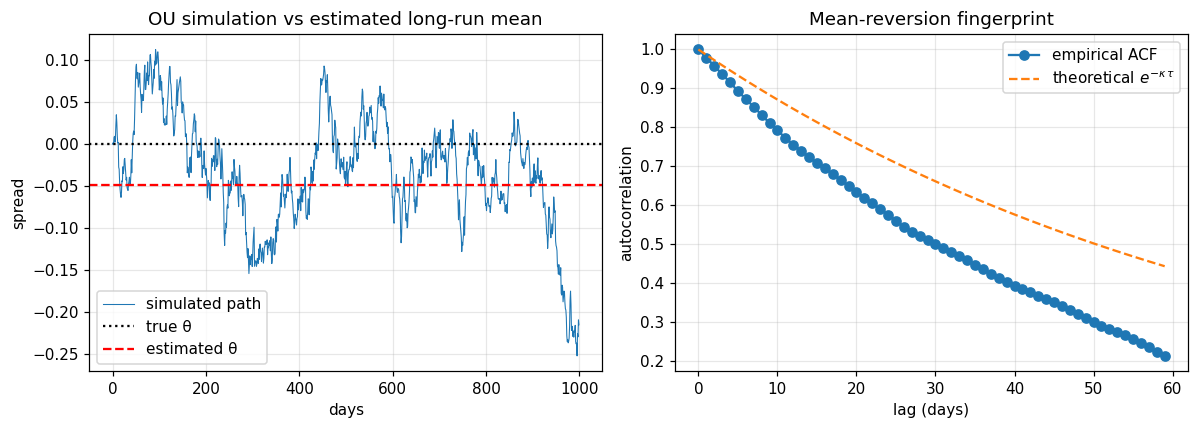
Method: Maximum likelihood estimation (MLE) using analytical formulas for discrete-time OU process.
Parameters:
spread: Time series of spread values (1D numpy array)dt: Time step in years (e.g., 1/252 for daily data, 1/52 for weekly)
Returns:
kappa: Mean reversion speed (annualized)theta: Long-run meansigma: Volatility (annualized)half_life: Half-life in time step units (\(\ln(2)/\kappa \cdot dt^{-1}\))
Practical tips:
Use at least 500-1000 observations for stable estimates
Check half-life: typical pairs have half-life 5-60 days
Winsorize extreme outliers (e.g., clip at ±5σ) if needed
For rolling estimates, use expanding or rolling windows of 250-500 periods
7. Kalman Filtering
State-space filtering for latent variable estimation and forecasting.
Implementation: src/optimal_control/kalman_filter.rs, src/optimal_control/kalman_py_bindings.rs
Linear Kalman Filter
For linear Gaussian state-space models: $\( \begin{aligned} x_{t+1} &= F x_t + B u_t + w_t, \quad w_t \sim \mathcal{N}(0, Q) \\ y_t &= H x_t + v_t, \quad v_t \sim \mathcal{N}(0, R) \end{aligned} \)$
Python API:
from optimizr import LinearKalmanFilter
import numpy as np

# Define system matrices
F = [[1.0, 1.0], [0.0, 1.0]]  # State transition (2×2)
H = [[1.0, 0.0]]              # Observation matrix (1×2)
Q = [[1e-4, 0.0], [0.0, 1e-4]]  # Process noise covariance
R = [[1e-2]]                  # Measurement noise covariance

# Initialize filter
kf = LinearKalmanFilter(
    f_matrix=F,
    h_matrix=H,
    q_matrix=Q,
    r_matrix=R,
    initial_state=[0.0, 0.0],
    initial_covariance=[[1.0, 0.0], [0.0, 1.0]],
)

# Online filtering loop
observations = np.random.randn(100)
states = []
for obs in observations:
    kf.predict(control=[0.0, 0.0])  # Prediction step
    kf.update(observation=[obs])     # Correction step
    state = kf.get_state()
    states.append(state)

states = np.array(states)
print(f"Final state estimate: {states[-1]}")
Use cases:
Tracking latent spread dynamics with noise
State estimation for control (e.g., estimate velocity from noisy position)
Online parameter adaptation
Extended Kalman Filter (EKF)
For nonlinear systems with local linearization.
Use case: Nonlinear spread dynamics, regime probabilities as states.
Unscented Kalman Filter (UKF)
For highly nonlinear systems using sigma-point approximation.
Python API:
from optimizr import UnscentedKalmanFilter

ukf = UnscentedKalmanFilter(
    state_dim=2,
    obs_dim=1,
    q_matrix=Q,
    r_matrix=R,
    initial_state=[0.0, 0.0],
    initial_covariance=[[1.0, 0.0], [0.0, 1.0]],
)
# Similar predict/update interface
Use case: Jump diffusion models, volatility estimation, option pricing.
8. Backtesting Framework
Backtests optimal switching strategies on historical data.
Implementation: src/optimal_control/backtest.rs
Python API:
from optimizr import backtest_optimal_switching_py

# First, get optimal thresholds
lower, upper, _, _ = solve_hjb_py(
    kappa=3.0, theta=0.0, sigma=0.2,
    rho=0.04, transaction_cost=0.001
)

# Backtest on historical spread
metrics = backtest_optimal_switching_py(
    spread=spread,              # Historical spread data
    lower_bound=lower,          # Optimal buy threshold
    upper_bound=upper,          # Optimal sell threshold
    transaction_cost=0.001,     # Must match HJB solver
)

(
    total_return,    # Cumulative return
    sharpe,          # Annualized Sharpe ratio
    max_dd,          # Maximum drawdown
    n_trades,        # Number of round-trip trades
    win_rate,        # Fraction of profitable trades
    pnl_path,        # P&L time series
) = metrics

print(f"Return: {total_return:.2%}, Sharpe: {sharpe:.2f}")
print(f"Max DD: {max_dd:.2%}, Trades: {n_trades}, Win rate: {win_rate:.2%}")

# Plot P&L path
import matplotlib.pyplot as plt
plt.figure(figsize=(12, 6))
plt.subplot(2, 1, 1)
plt.plot(spread, label='Spread')
plt.axhline(lower, color='r', linestyle='--', label='Lower')
plt.axhline(upper, color='g', linestyle='--', label='Upper')
plt.legend()
plt.subplot(2, 1, 2)
plt.plot(pnl_path, label='P&L')
plt.legend()
plt.tight_layout()
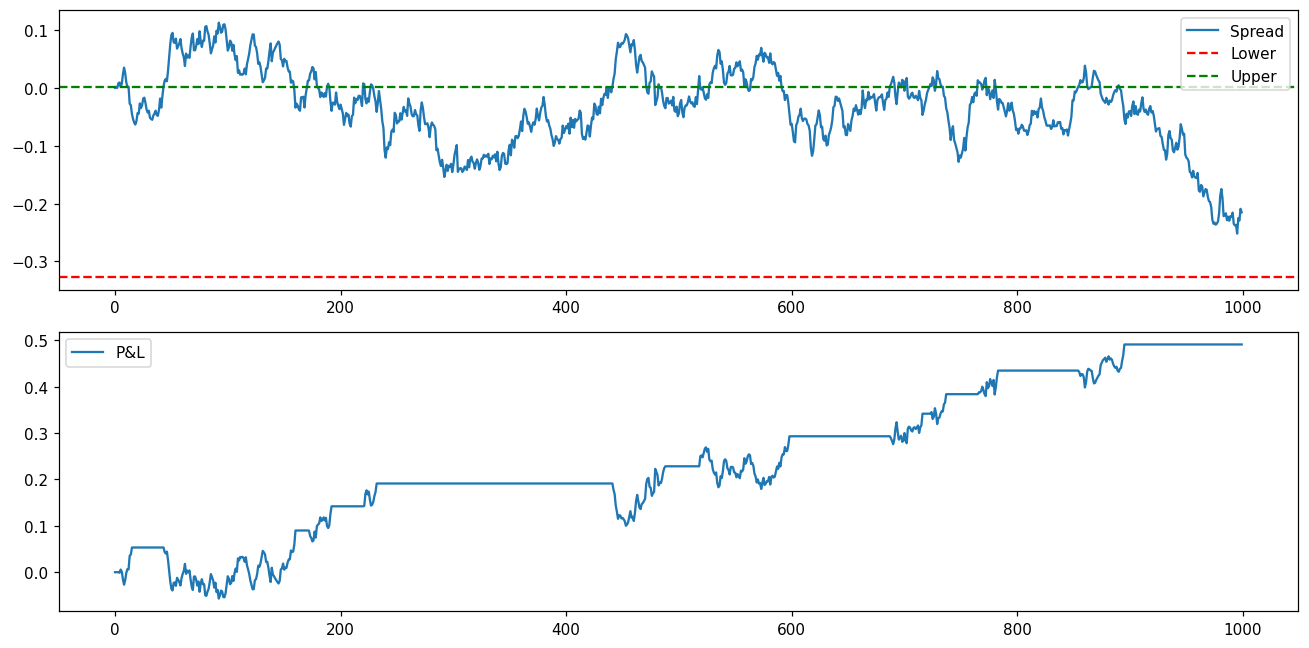
Metrics interpretation:
total_return: Should be positive with low transaction costssharpe: Good values > 1.0, excellent > 2.0max_dd: Risk metric, compare to expected returnn_trades: Too many → excessive costs; too few → missing opportunitieswin_rate: Typically 40-60% for mean-reversion strategies
Parameter tuning:
If
win_ratelow butmax_ddhigh → bands too narrow, increasetransaction_costorrhoIf
n_tradeslow → bands too wide, decreasetransaction_costorrhoCompare Sharpe ratios across different parameter settings
Complete Workflow Example
Here’s a complete optimal control pipeline for pairs trading:
import numpy as np
import pandas as pd
from optimizr import (
    estimate_ou_params_py,
    solve_hjb_py,
    backtest_optimal_switching_py,
    HMM
)

# 1. Load price data (example with simulated data)
np.random.seed(42)
T = 5000
dt = 1/252

# Simulate cointegrated pair
price_A = 100 * np.exp(np.cumsum(0.0001 + 0.01*np.sqrt(dt)*np.random.randn(T)))
price_B = 100 * np.exp(np.cumsum(0.0001 + 0.01*np.sqrt(dt)*np.random.randn(T)))
spread = np.log(price_A) - np.log(price_B)

# Split into train/test
train_spread = spread[:3000]
test_spread = spread[3000:]

# 2. Estimate OU parameters
kappa, theta, sigma, half_life = estimate_ou_params_py(train_spread, dt=dt)
print(f"OU parameters: κ={kappa:.2f}, θ={theta:.3f}, σ={sigma:.3f}")
print(f"Half-life: {half_life:.1f} days")

# 3. Solve HJB for optimal thresholds
lower, upper, residual, iters = solve_hjb_py(
    kappa=kappa,
    theta=theta,
    sigma=sigma,
    rho=0.04,
    transaction_cost=0.001,
    n_points=400,
    max_iter=2000,
    tolerance=1e-7,
)
print(f"Optimal thresholds: ({lower:.3f}, {upper:.3f})")
print(f"Converged in {iters} iterations, residual={residual:.2e}")

# 4. Backtest on out-of-sample data
metrics = backtest_optimal_switching_py(
    spread=test_spread,
    lower_bound=lower,
    upper_bound=upper,
    transaction_cost=0.001,
)
total_return, sharpe, max_dd, n_trades, win_rate, pnl_path = metrics

print(f"\nBacktest Results:")
print(f"  Total Return: {total_return:.2%}")
print(f"  Sharpe Ratio: {sharpe:.2f}")
print(f"  Max Drawdown: {max_dd:.2%}")
print(f"  # Trades: {n_trades}")
print(f"  Win Rate: {win_rate:.2%}")

# 5. Optional: Regime-aware control with HMM
returns = np.diff(train_spread)
hmm = HMM(n_states=2)
hmm.fit(returns.reshape(-1, 1), n_iterations=100)
regimes = hmm.predict(returns.reshape(-1, 1))

# Estimate OU per regime and get regime-specific thresholds
for regime_id in range(2):
    mask = (regimes == regime_id)
    spread_regime = train_spread[1:][mask]
    k, t, s, _ = estimate_ou_params_py(spread_regime, dt=dt)
    l, u, _, _ = solve_hjb_py(k, t, s, 0.04, 0.001)
    print(f"Regime {regime_id}: κ={k:.2f}, thresholds=({l:.3f}, {u:.3f})")
Performance Characteristics
Computational Complexity
HJB Solver: \(O(N \cdot K)\) where \(N\) is
n_points, \(K\) is policy iterations (~10-50)OU Estimation: \(O(T)\) where \(T\) is time series length (closed-form MLE)
Kalman Filter: \(O(T \cdot d^3)\) where \(d\) is state dimension (matrix inversion per step)
Backtesting: \(O(T)\) single pass through data
Typical Runtimes (on modern CPU)
HJB solve (400 points): ~10-50ms
OU estimation (5000 samples): ~1ms
Kalman filter (1000 steps, 2D state): ~10ms
Backtest (5000 samples): ~5ms
Memory Requirements
HJB solver: \(O(N)\) for grid storage (~few KB)
Kalman filter: \(O(d^2)\) for covariance matrices (~few KB for small \(d\))
Backtesting: \(O(T)\) for P&L path storage (~few MB for long histories)
Integration with Other Modules
With Mean Field Games
Use optimal control as individual agent strategy
Aggregate across population for mean-field dynamics
See
algorithms/mean_field_games.mdfor MFG theory
With Sparse Optimization
Use Kalman-filtered states as inputs to sparse controllers
Combine L1-regularized control with HJB thresholds
See
algorithms/sparse_optimization.md
Troubleshooting
HJB solver not converging
Symptom:
residual > toleranceaftermax_iterFix: Increase
max_iter(try 5000-10000); reducetolerancerequirement; check that OU parameters are reasonable
Thresholds outside grid bounds
Symptom: Optimal thresholds at grid edges
Fix: Increase
n_std(try 6-8); check OU parameter estimates (very high σ needs wider grid)
OU estimates unstable
Symptom: Negative
kappaor extremehalf_lifeFix: Use more data (>1000 samples); check for non-stationarity; consider winsorizing outliers
Backtest Sharpe ratio low
Symptom: Sharpe < 0.5 despite positive thresholds
Fix: Check for regime changes (use HMM); verify spread is actually mean-reverting; adjust
transaction_costin HJB solver
Kalman filter diverging
Symptom: State estimates exploding
Fix: Check process noise
Qis not too large; verify observations are scaled properly; use UKF for strong nonlinearity
References
Optimal Control Theory
Fleming, W. H., & Soner, H. M. (2006). Controlled Markov Processes and Viscosity Solutions. Springer.
Øksendal, B. (2003). Stochastic Differential Equations: An Introduction with Applications (6th ed.). Springer.
Pham, H. (2009). Continuous-time Stochastic Control and Optimization with Financial Applications. Springer.
Viscosity Solutions
Barles, G., & Souganidis, P. E. (1991). Convergence of approximation schemes for fully nonlinear second order equations. Asymptotic Analysis, 4(3), 271-283.
Crandall, M. G., Ishii, H., & Lions, P.-L. (1992). User’s guide to viscosity solutions of second order partial differential equations. Bulletin of the American Mathematical Society, 27(1), 1-67.
Kalman Filtering
Kalman, R. E. (1960). A new approach to linear filtering and prediction problems. Journal of Basic Engineering, 82(1), 35-45.
Julier, S. J., & Uhlmann, J. K. (1997). New extension of the Kalman filter to nonlinear systems. Signal Processing, Sensor Fusion, and Target Recognition VI, 3068, 182-193.
Financial Applications
Avellaneda, M., & Lee, J.-H. (2010). Statistical arbitrage in the US equities market. Quantitative Finance, 10(7), 761-782.
Gatev, E., Goetzmann, W. N., & Rouwenhorst, K. G. (2006). Pairs trading: Performance of a relative-value arbitrage rule. The Review of Financial Studies, 19(3), 797-827.
See Also
HMM API Reference - Hidden Markov Models for regime detection
Mean Field Games - Population-level optimal control
Optimal Control API - Complete function signatures and types